The first permanent settler in the area was a Scottish trader called James McQueen in 1716. The county of Montgomery was created in 1816, named after military officer Lemuel P. Montgomery rather than the Welsh market town of the same name. The city of Montgomery came into existence in 1819 and in 1846 it became the capital of Alabama. For a few months in 1861 it was also the capital of the Confederacy. Long after the Civil war was lost by the Confederacy, Montgomery became a focus for the Civil Rights movement. The city imposed segregation on its buses, whites at the front, blacks at the back with whites taking priority for seats. In 1955 Rosa Parks was arrested after she refused to give up her seat to a white man. This sparked a boycott of bus services until in 1956 Mongomery’s segregation laws were ruled unconstitutional by the Supreme Court..
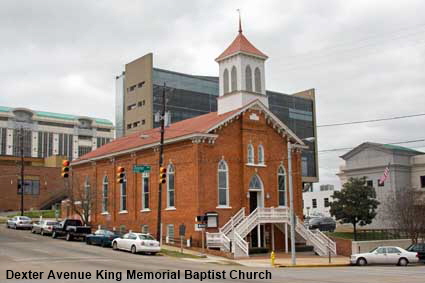
Dexter Avenue King Memorial Baptist Church
The Second Colored Baptist Church was established in Montgomery in 1877. The original church on Market Street was a small timber framed building completed in 1879. Between 1883 and 1889 this was replaced by a red brick church on the same site. When Market Street was renamed Dexter Avenue in honour of city founder Andrew Dexter, the Church became the Dexter Avenue Baptist Church. Between 1954 and 1960 the twentieth pastor of the church was Dr. Martin Luther King, Junior. He organised the Montgomery Bus Boycott from his office in the basement. In 1978 the church was renamed the Dexter Avenue King Memorial Baptist Church in his memory.
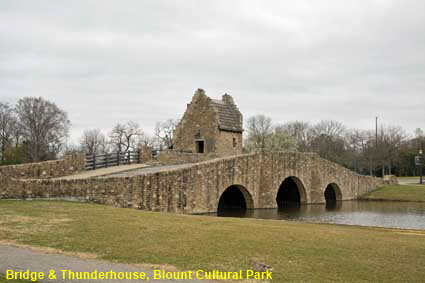
Bridge & Thunderhouse, Blount Cultural Park
On the eastern outskirts of Montgomery is a taste of England. Plans for Blount Cultural Park were developed in 1983 by Tom Blount, son of park benefactor Wynton M. Blount. Architects aimed to create romantic buildings inspired by the picturesque English countryside. The park has a Museum of Fine Arts, a Shakespeare Garden & Amphitheatre and a Palladian style theatre which is the home of the Alabama Shakespeare Festival. One quirky building in the park is the bridge across an artificial lake near the southern end of the park, complete with a ‘Thunderhouse’ to provide both shelter from the rain and a viewing deck to look out over the weir and lake.
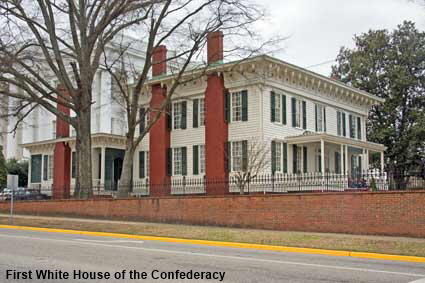
First White House of the Confederacy
On February 4, 1861 representatives of the states that had seceded from the USA met in Alabama’s State Capitol building to form the Confederate States of America. Four days later they elected Jefferson Davis as the President of the Confederacy. For an executive mansion, they rented an 1835 town house on the corner of Bibb and Lee Streets. The Confederate Politicians did not like the heat in Montgomery so in May 1861 the Provisional Congress voted to move the capital to Richmond in Virginia and by the end of the month Jefferson Davis had moved there. In 1921 the house was relocated to 644 Washington Avenue. The house has been restored to the way it would have looked in Davis’s time and is open to the public at no charge. Click Tab 2 to see the President's Study
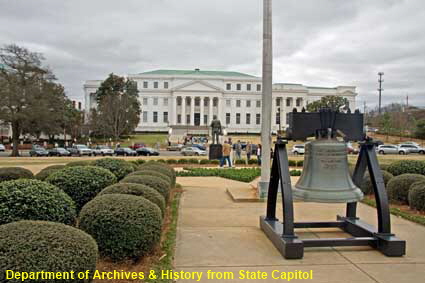
Department of Archives & History from State Capitol
Like most State capitals, Montgomery is not short of symbols of US history and monumental buildings. This picture taken from the State Capitol has both, a replica of the Liberty Bell and the Alabama Department of Archives & History building. Alabama has the oldest state funded archives in the USA. The marble building that houses the archives was completed in 1940, and in addition to the archives it features museum galleries and a genealogical research facility. Exhibits include the Alabama Indians, military history and 19th century history. There is also a hands-on gallery for children called ‘Grandma's Attic’.
Click on Minimap to navigate
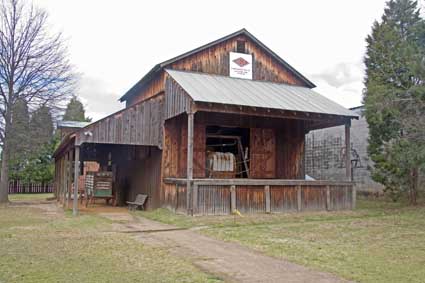
Cotton Gin, Old Alabama Town
Plantation Cotton Gins were once commonplace across Alabama, but now they have gone. Daniel Pratt designed one of the most successful gins and in 1853 he built a large plant to manufacture them at Prattville in Alabama. In 1899 his factory was part of a merger of five large Cotton gin manufacturers to form the Continental Gin Company. This rare two-stand cotton gin and press was installed by Continental in the early 1900s at Teasley's Mill, Alabama. In the 1990s it was moved to Old Alabama Town and fully restored to its original condition. Sadly, is not operated courtesy of modern safety requirements and because it was not designed to handle the amount of trash found in modern machine-picked cotton. Click Tab 2 to see the interior of the Cotton Gin.


DLU110105
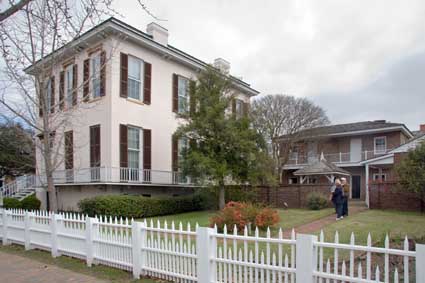
Ordeman Town House, Old Alabama Town
Downtown Montgomery has six blocks of restored 19th and early 20th century buildings that are typical of central the Alabama architecture of the period. Old Alabama Town seeks out historic properties that are at risk, restores them to their original style and purpose and displays then to the public as outdoor history museum. Most of the museum can be viewed on a self-guided tour, but the Ordeman House has to be visited on a guided tour, included in the price of admission. It is an Italianate Town House built for Charles C. Ordeman and his family in 1852. It is still on its original site together with its original slaves quarters, outside kitchen and courtyard. The main house has genuine Victorian furniture to show how the interior would have looked in Ordeman’s day. Click Tab 2 to see the Outside Kitchen.


Montgomery



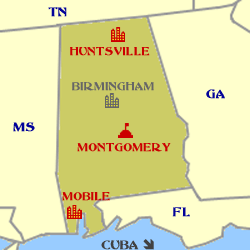
To move forwards or backwards through the Alabama trail click the arrows above, or select your next destination on the Minimap.


© Mike Elsden 1981 - 2025
The contents of this page may not be reproduced in full or in part without permission

