The City of Mobile has a truly international history. The Spanish first explored Mobile Bay around 1519, but it was the French who settled the area, establishing Fort Louis de la Louisiane on the Mobile River in 1702 as the first capital of the French colony of Louisiana. In 1711 to escape disease the settlement was moved to the mouth of the river and in 1723 Fort Condé was built to improve defences. The 1763 Treaty of Paris which ended the French & Indian War gave Canada and West Florida, including Mobile, to the Britain. British rule in Mobile was to last only 17 years as in 1780 at the height of the Revolutionary War, Spanish forces took Fort Charlotte (Fort Condé renamed by the British) and they retained Mobile at the end of the war. Spain controlled Mobile until 1813 when it was captured by US forces and it became part of the Mississippi Territory until it was split in in 1817 to form the Alabama Territory.
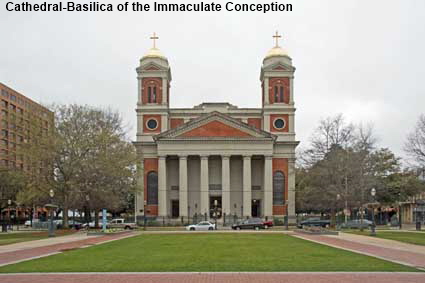
Cathedral-Basilica of the Immaculate Conception
A Catholic Church was built in 1703 in the original French settlement. When Mobile moved to its present site in 1711, a new parish church was built, Notre Dame de la Mobile. In 1829 Mobile became a diocese so plans were prepared for a cathedral. Designed by Claude Beroujon, construction of the Cathedral-Basilica of the Immaculate Conception started in 1835 but it wasn‘t completed until 1850. It is renowned for its stained glass windows which were made in Munich and installed between 1890 and 1910. The cathedral has survived several hurricanes and a fire.
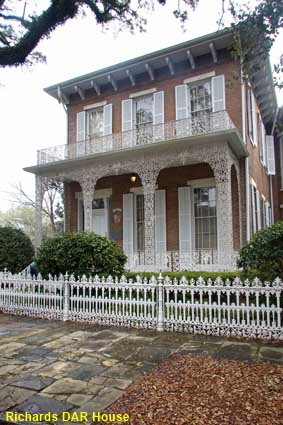
Richards DAR House
Mobile has several Historic Districts. The De Tonti Square Historic District covers and area around 3 blocks square which was placed on the National Register of Historic Places in 1972. It contains many examples of town houses built between 1840 and 1860 in the Federal, Greek Revival, and Italianate architectural styles. One of the best examples of the Itanianate style is the Richards DAR House at 250 Joachim Street. The house with its lavish cast iron lace work was built in 1860 for Steamboat Captain Charles G. Richards and his wife. It remained in the same family until 1946 when it was purchased by the Ideal Cement Company. In 1973 ownership passed to the City of Mobile who leased the house to the six Mobile Chapters of the Daughters of the American Revolution. It is now open the public as the Richards – Daughters of the American Revolution House Museum.
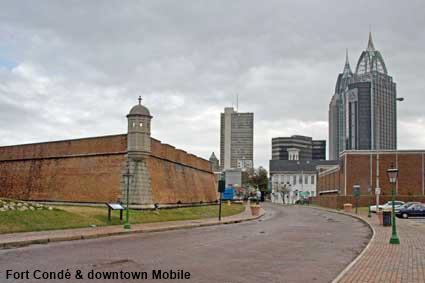
Fort Condé & downtown Mobile
From its construction in 1723 Fort Condé lasted through French rule, British rule (as Fort Charlotte) and Spanish rule (as Fort Carlota). When the US took control, it it had little regard for the fort’s historical significance. All it saw was was an outdated military structure standing in prime downtown location so in 1820 it was torn down to allow new streets to be built. In the 1970s as part of the celebration of the US bicentennial a replica was built of about one third of Fort Condé at 80% of the original scale. The replica serves as the official Welcome Center for the City of Mobile and visitors can explore its walls and rooms.
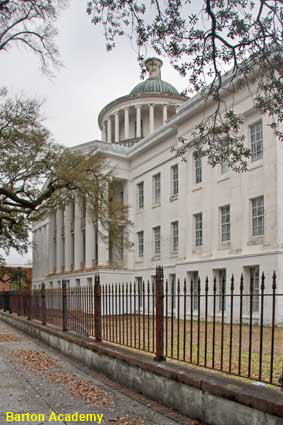
Barton Academy
Construction of the Barton Academy began in 1836. The Greek Revival school building was named after Willoughby Barton who in 1826 introduced legislation to create a Board of School Commissioners in Mobile County. Construction proved complex and the building was not completed until 1839. The name Barton Academy is a little misleading as building but housed several private and denominational schools. It was used a school building up to the 1960s when it was converted into offices for the county school authorities. The building has been subjected to some major additions and changes over the years. It has been empty since 2007 and attempts are being made obtain enough funding to restore it back to its former glory.
Mobile
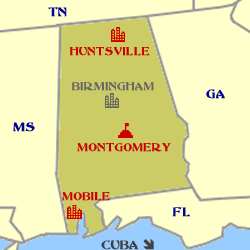
Click on Minimap to navigate
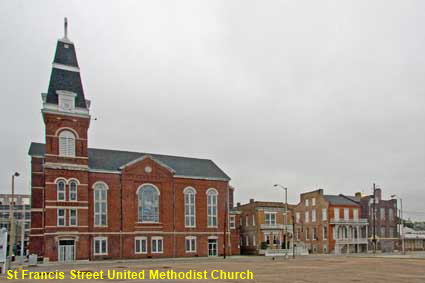
St Francis Street United Methodist Church
It has proved difficult to track down information on this fine historic church on Joachim Street at St Francis Street as the National Park Service has yet to include documentation on it on its web site. It appears that the St. Francis Street United Methodist Church was built in 1896 by the architectural firm of Watkins & Johnson, and it was placed on the National Register of Historic Places in 1984.
DLU110103
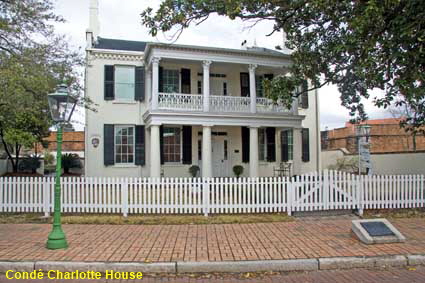
Condé Charlotte House
The Church Street East Historic District includes an enclave by the I-10 next to the replica of Fort Condé. Some of the buildings in this enclave are in dire need of renovation, but one that has been well looked after is the Condé Charlotte House in Theatre Street. It was built in 1850 by Jonathan and Elizabeth Kirkbride on the site of an 1822 jail. When the Historic Mobile Preservation Society purchased the house in 1940, they discovered the outline of 4 small cells in the thick brick floor. The house is now owned by the National society of Colonial Dames of America in the state of Alabama who have restored it and opened it to the public as a museum.


To move forwards or backwards through the Alabama trail click the arrows above, or select your next destination on the Minimap.
Condé Charlotte House



© Mike Elsden 1981 - 2025
The contents of this page may not be reproduced in full or in part without permission

