John Hunt was the first resident here in 1805, but he failed to register his claim and the land was bought by Leroy Pope who named the town Twickenham after the home town in England of his distant relative, poet Alexander Pope. In 1811, Twickenham became the first incorporated town in Alabama. The War of 1812 created much anti-British sentiment, so the name was changed to Huntsville, after its first resident. The Civil War saw the townsfolk initially opposing secession from the Union, but many men from the town fought on the Confederate side. Huntsville was taken by Union troops in April 1862, but after a few months they were forced to abandon it. The town was again taken by the Union side in autumn 1863 was was held for the rest of the Civil War. This spared the town from the destruction that befell many other towns in the area, leaving much of its history intact.
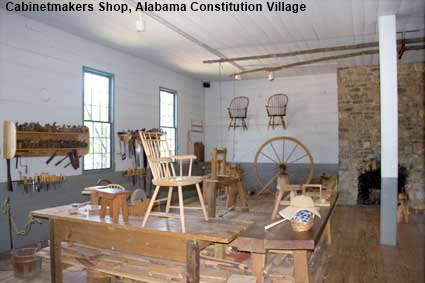
Cabinetmakers Shop, Constitution Hall, Alabama Constitution Village
Huntsville is where in 1819 delegates from across the Alabama Territory met to draft the constitution necessary for statehood. There was no hall large enough for the 44 delegates, so they took over the vacant shop of Cabinetmaker Walker Allen who had died not long before. Alabama Constitution Village is a block from 1819 Huntsville, with reconstructed buildings built on the original foundations. The Cabinetmakers shop, which became known as Constitution Hall, is the first port of call on the tour. Other reconstructed buildings include John Boardman's print shop, Clement Comer Clay's law office, the Federal Land Surveyor's office, a post office and the residence of sheriff Stephen Neal.
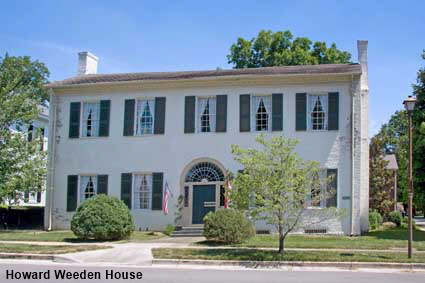
Howard Weeden House
The Twickenham district of Huntsville is where you will find the the antebellum houses that were spared from destruction during the civil war. Most are private, but the Howard Weeden House is a museum open to the public. This Federal style house was built in 1819 for Henry C. Bradford. Dr. William Weeden bought the house for his family in 1845 but died soon after. His daughter, poet and artist Maria Howard Weeden (1846-1905) was born and lived her life here, apart from a spell during the civil war when the house was used as headquarters for Union officers and the Weeden family moved in with relatives in relatives in Tuskegee, Alabama. Howard Weeden (as she was known), took up painting to supplement the family’s income. and her paintings of of former slaves made her famous.
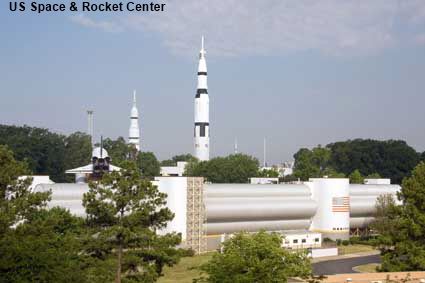
US Space & Rocket Center
In the spring of 1950, a team of 118 German scientists working for the Army rocket program under the direction of Wernher von Braun was relocated from Fort Bliss in Texas to the Redstone Arsenal in Huntsville. In 1960, Redstone Arsenal was renamed the Marshall Space Flight Center, responsible for developing rockets for the US Space Program, including the giant Saturn V rocket used for the Apollo moon landings. The US Space & Rocket Center serves both as a NASA Visitor Center and as a museum dedicated to the hardware used for US manned space flights. A huge Saturn V rocket dominates the centre of this picture taken from the adjacent Marriott hotel, while a space shuttle is visible near the left.
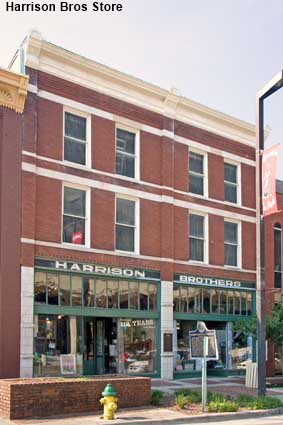
Harrison Bros Store
In 1879 by brothers James and Daniel Harrison founded a tobacco store on Jefferson Street, Huntsville. The business moved to the South Side of the Square in 1897, with the youngest brother Robert S. Harrison, running the store alongside older brother Daniel. Robert's sons, Daniel F. and John, took over in the 1950s by which time the shop sold mainly hardware, furniture, and crockery. Daniel and John did not adopt modern merchandising techniques, thereby preserving the store in its turn-of-the-century condition. Following the death of John in 1983 the store was under threat, so the Historic Huntsville Foundation bought it. The Harrison Brothers Store now operates as both a store and a museum, with the higher shelves and cabinets crammed with historic stock which is not for sale. Click Tab 2 to see the interior of the store.
Huntsville
Click on Minimap to navigate


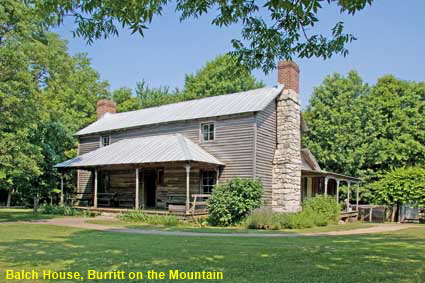
Balch House, Burritt on the Mountain
A typical example of the preserved buildings at Burritt on the Mountain is the Balch House. Built by Samuel Balch in 1887, it was originally a single story dog-trot house located on a 65 hectare (160 acre) farm in Nebo (now Madison), Alabama. Dog-trot houses were two log cabins with a breezeway (or dogtrot) between them under a common roof. Typically one cabin was for cooking and dining while the other housed the bedrooms. Samuel extended the house in 1898 by enclosing the dog- trot to form a central hall and added a half-story to the original log structure. He also added a guest bedroom and post office. Click Tab 2 to see the kitchen.


DLU090731
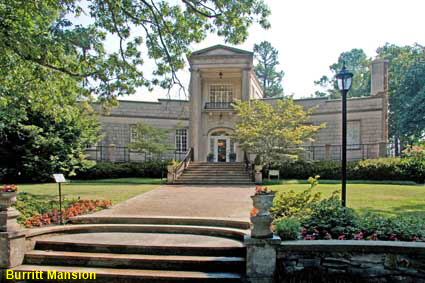
Burritt Mansion
Huntsville also has some memorable buildings from the 20th century. Dr. William Henry Burritt, physician and inventor built this mansion on a mountain overlooking Huntsville in 1936.t was intended to be a retirement home, but Burritt was ready for a leisurely life. In the 68 hectare (167 acre) grounds he operated a farm here, ran many agricultural experiments and invented many gadgets. On his death in 1955, Dr Burritt willed the mansion and grounds to the city of Huntsville as a museum and public park. Burritt on the Mountain has preserved Dr. Burritt’s Mansion and the ground are home to a range of 19th century buildings for the locality.


To move forwards or backwards through the Alabama trail click the arrows above, or select your next destination on the Minimap.



© Mike Elsden 1981 - 2025
The contents of this page may not be reproduced in full or in part without permission

