The Rappahannock River runs inland from Chesapeake Bay and just before the point where falls ended navigation of the river, a town sprang up. It was named Fredericksburg in honour of Frederick, the Prince of Wales and son of King George II. In 1728 it became an official inland port and it prospered from tobacco trading. George Washington’s family moved to Ferry Farm on the opposite side of the Rappahannock River in 1738. The town was out of the reach of the the British Navy, so it became a centre for manufacturing munitions during the Revolutionary War. Fredericksburg had a hard time during the Civil War but its heritage survived. A 40 block national historic district contains more than 350 buildings dating to the 18th and 19th centuries.
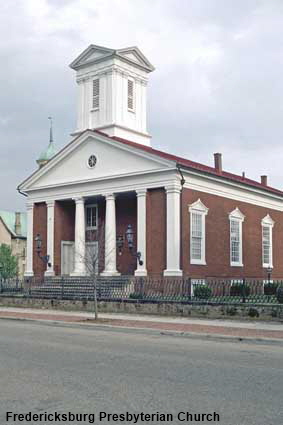
Fredericksburg Presbyterian Church
The Greek Revival style Presbyterian Church was built in 1833 and is one of the two oldest churches in Fredericksburg. It was severely damaged during the Civil War, and the Confederates melted down the church bell to make cannon. The church became a Union hospital for thousands of soldiers injured during the Battles of Wilderness and Spotsylvania Courthouse. Clara Barton, founder of the American Red Cross, worked in the church when it was a hospital. After the Civil war the building reverted to being a Presbyterian Church and it is still in use today. Just visible above the left of the church is the top of the tower of Fredericksburg Courthouse, a Gothic Revival style building built in the 1850s.
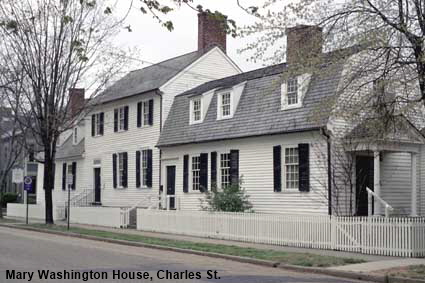
Mary Washington House, 1200 Charles St.
Records don’t identify when this house was built but they do show that George Washington purchased it in 1772 for his mother to live out her later years. Mary Ball Washington wanted to be close to her daughter Betty Fielding Lewis and the house was within walking distance of Kenmore, where Betty lived. In 1789 George Washington visited the house to receive his mother's blessing before attending his inauguration as President. Mary Washington spent her last seventeen years in the house. The Association for the Preservation of Virginia Antiquities acquired it in 1891 to save it from being removed for display at the Chicago World's Fair. The house was restored and opened to the public. A number of Mary Washington’s possessions are on display in the house.
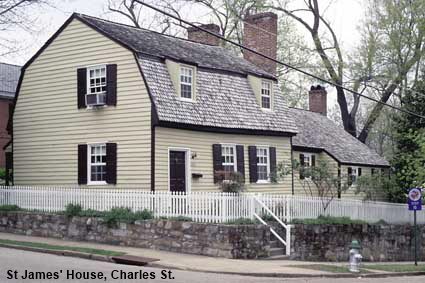
St James' House, 1300 Charles Street
The St. James' House was built around 1768 by attorney James Mercer. Only a small part of the timber frame house dates back to the eighteenth-century, namely the entry hall, the parlour and the dining room on the ground floor and a bedroom upstairs. St. James' House was restored in the mid 1960s by Daniel Breslin and William Tolerton who furnished it with period furniture and artworks. The house is used as a private residence and is normally open to the public only three weeks each year.
Fredericksburg
Click on Minimap to navigate
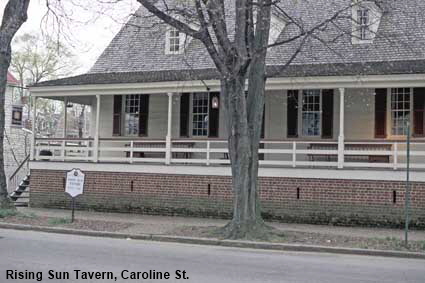
Rising Sun Tavern, 1304 Caroline St.
This was originally a private home built around 1760 by George Washington’s youngest brother Charles. In 1792 the timber frame building became a tavern serving the bustling town of Fredericksburg. The Association for the Preservation of Virginia Antiquities acquired the Rising Sun Tavern in 1907. Although the building was restored in the 1930s, much of the woodwork is still original. The tavern is filled with period furnishings and ‘Tavern Wenches’ give visitors an insight into 18th century tavern life.
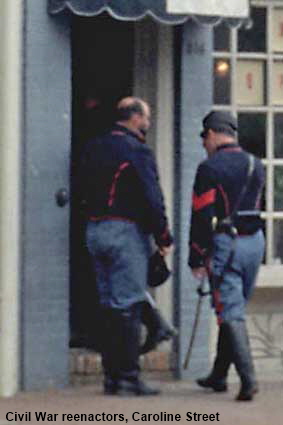
Civil War reenactors, Caroline Street
Fredericksburg had the misfortune to be located halfway between the two Civil War capitals of Washington DC and Richmond VA. As a result it was fought over for three years. In December 1862 Union troops bombarded the city and entered parts of it but Confederate troops defending the heights above the city were able to hold off repeated Union attacks. A rematch in the spring of 1863 took place just outside the city, at a country crossroads called Chancellorsville. The battles of the Wilderness and Spotsylvania Court House were fought nearby in May 1864. Fredericksburg’s Civil War past is not forgotten. Close to the city Fredericksburg and Spotsylvania National Military Park covers four major Civil War battlefields, the Battle of Fredericksburg, Battle of Chancellorsville, Battle of the Wilderness and Battle of Spotsylvania Court House. While we were in Fredericksburg we came across people in Civil War uniforms, who had been reenacting one of the battles.
DLU100712



To move forwards or backwards through the Virginia trail click the arrows above, or select your next destination on the Minimap.


© Mike Elsden 1981 - 2025
The contents of this page may not be reproduced in full or in part without permission

