It was tobacco farming that helped the original settlement at Jamestown to survive, and it became the main crop of the colony and later the state. Although production of other crops has now surpassed tobacco, Virginia remains the fifth largest producer of tobacco in the USA. We visited three plantations along or close to the James River. A good plantation needed three things, fertile land, an plentiful supply of labour and good transport links. The James River had fertile land and it also provided the necessary transport link to bring in slave labour and to ship out the tobacco.
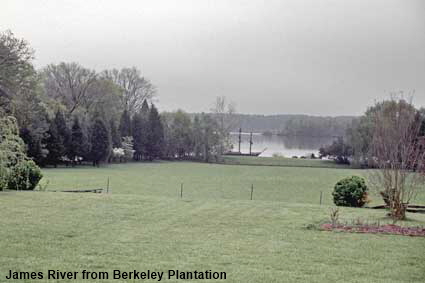
James River from Berkeley Plantation
In 1619 a group of 38 English settlers landed about 32 kilometres (20 miles) upstream from Jamestown. They named the 3,200 hectare (8,000 acre) tract of land Berkeley Hundred. When the settlers came ashore at Berkeley they observed the first official Thanksgiving in America. Berkeley Hundred was abandoned after 9 settlers were killed during the 1622 Indian Massacre. After a few years the land was resettled by the Harrison family who named it Berkeley Plantation.
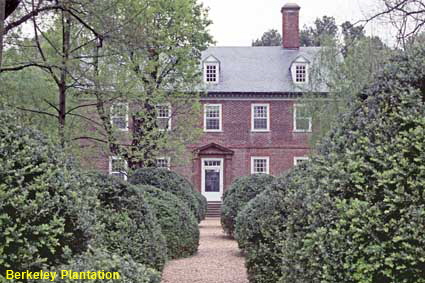
Berkeley Plantation
The present mansion at Berkeley Plantation was built in 1726 by Benjamin Harrison IV and it is thought to be the oldest 3 story brick house in Virginia. The plantation passed to his son Benjamin Harrison V who signed the Declaration of Independence and became Governor of Virginia. The Harrison family lost the plantation during the Civil War and it fell into disrepair. It was bought in 1907 by Scotsman John Jamieson and his son Malcolm inherited it in 1927. Malcolm Jamieson and his wife, Grace restored the mansion at Berkeley Plantation, and it is now a major tourist attraction.
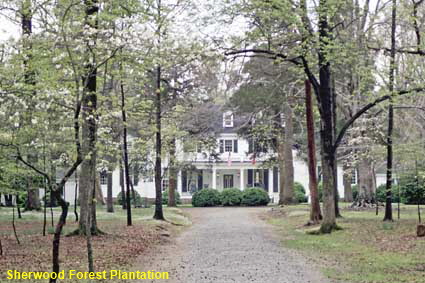
Sherwood Forest Plantation
A plantation on this site called Smith's Hundred was first recorded in a 1616 land grant. Later it was known as Walnut Grove Plantation. The Big House at the plantation is the longest timber framed residence in the USA at over 90 metres (300 feet) in length. Parts of the house date back to the 1720s but later additions elongated the structure. The plantation was bought by US President John Tyler in 1842 and he renamed it ‘Sherwood Forest’ because he considered that he had been outlawed by the Whig party and hence likened himself to Robin Hood. Sherwood Forest Plantation is still owned by descendants of President Tyler. The grounds are open for self guided tours but the house remains the residence of the Tyler family and can only be toured by appointment.
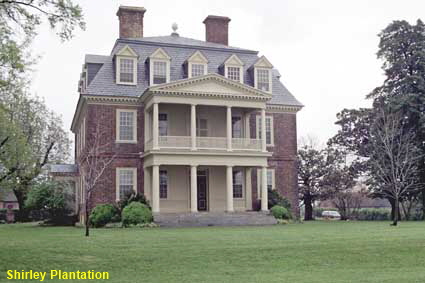
Shirley Plantation
This was the first plantation to established in Virginia, dating back to 1613, just six years after Jamestown was settled. The plantation was established by Sir Thomas West, Baron De la Warr whose title is the origin of the name Delaware. In 1638 180 hectares (450 acres) of the land were granted to Edward Hill whose descendants still own the plantation. The plantation expended over the years through marriage and land acquisition. The Great House now standing on the plantation was completed in 1738 by John Carter who had married Elizabeth Hill. It is still occupied by members of the Carter family and the plantation is still operational. The Great House at Shirley Plantation is open for guided tours.
Plantations
Click on Minimap to navigate
DLU100713



To move forwards or backwards through the Virginia trail click the arrows above, or select your next destination on the Minimap.


© Mike Elsden 1981 - 2025
The contents of this page may not be reproduced in full or in part without permission

