We didn’t plan to explore Spokane, it was just a place with plenty of hotels for an overnight stay on our way to Montana. We arrived early and so had a look round to find that Washington’s second largest city had a lot to offer. A fur trading post called Spokane House was set up around 1810, but the city traces its roots back to a sawmill set up in 1871 by the falls on the Spokane River. James Glover bought the sawmill and much of the land now occupied by the business district in 1873. In 1881 the Northern Pacific Railway arrived and the city of Spokane Falls was founded, changed to just Spokane in 1883. Glover helped to plan and build the city and in 1889 after 27 blocks burned down he instigated rebuilding in brick and stone. Spokane was put on the map in 1974 as the site of the World's Fair and is now a city of around 200,000 people. In 2016 revisited once again on our way to Montana, and this time we discovered that Spokane was Bing Crosby’s childhood home.
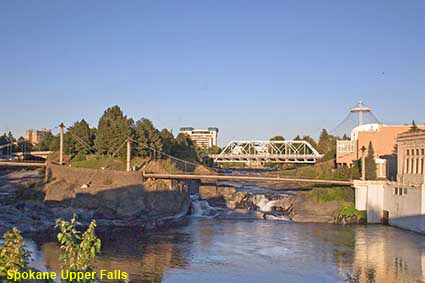
Spokane Upper Falls
Old photographs of Spokane show a torrent of water thundering over Spokane Upper Falls, but nowadays there is little more than a trickle. The villain of the piece is the hydroelectric power station on the extreme right of this picture. The footbridges above the falls were built for Expo ‘74. The tent shaped structure above the power station is the remains of the Expo ‘74 Pavilion which at the time was covered in canvas but is now just a skeletal structure standing over an ice skating rink.
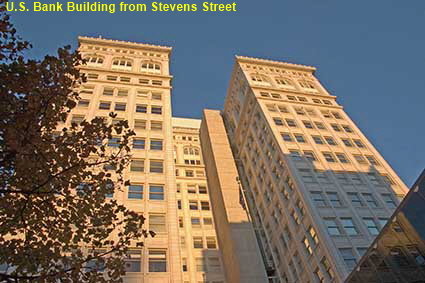
U.S. Bank Building from Stevens Street,
Spokane has many modern buildings, but a good number of its old buildings have survived. The U.S. Bank Building and the nearby Paulsen Center are probably the best known ‘old timers’ in the city. The U.S. Bank Building used to be known as the Old National Bank Building. Completed in 1910, this 66 metre (217 foot) high glazed terracotta building was designed by architect Daniel H. Burnham in the Chicago School of Architecture style. Even though it has only 16 floors, it remains a prominent landmark on the Spokane skyline.
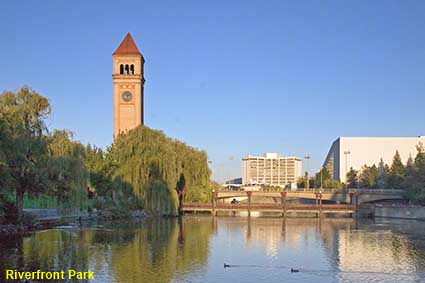
Riverfront Park
In an era when the USA is perceived to be dragging its feet on issues like Global Warming, it is surprising to find that the 1974 World’s Fair held in Spokane had the environment as its theme. The Fair, known as Expo ‘74, was held on Spokane’s riverfront, an area that had gone into sharp decline after World War II and was crying out for redevelopment. Visitors to the Fair reached 5.2 million, and Spokane was put on the world map. The site where Expo ‘74 was held is now Riverfront Park, and a number of structures from the Fair have been retained. The tower by the river in this picture was the Expo ‘74 Clock Tower.
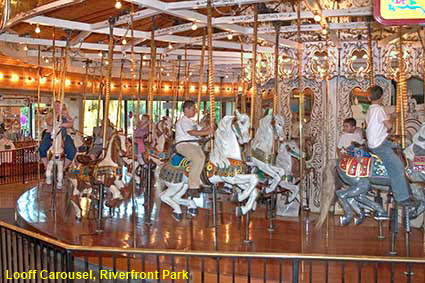
Looff Carousel, Riverfront Park
Riverfront Park is home to the historic Looff Carousel, built in 1909 and still fully operational. Charles I.D. Looff, was one of the foremost US carousel designers in the late 19th and early 20th centuries. Many of his carousels have been preserved across the USA, all with beautifully painted figures hand carved from wood, and unlike British carousels, protected from the weather within a building. The Spokane carousel boasts 54 carved horses, one giraffe, one tiger and two Chinese dragon chairs. Click Tab 2 to see the exterior of the carousel in its Riverfront Park setting.
Spokane
Click on Minimap to navigate
Home > US States > The West > Washington State >
DLU161123
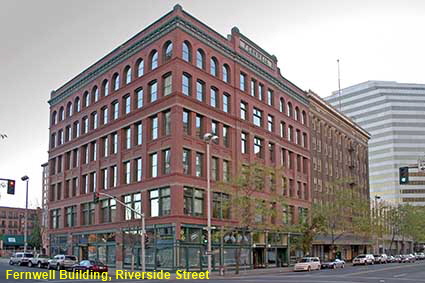
Fernwell Building, Riverside Street
After the 1889 fire, Rollin Charles Hyde engaged Herman Preusse to design a new a Chamber of Commerce Building. It was completed in 1891 and in 1893 was renamed the Fernwell Building. For over 90 years the ground floor was a men’s clothing store. The next two floors were office space for prominent doctors, lawyers, dentists, architects and insurance firms while the top floors were a hotel. The building was renovated in 1985 and is now used as high technology offices and executive suites.





To move forwards or backwards through the Washington State trail click the arrows above, or select your next destination on the Minimap.


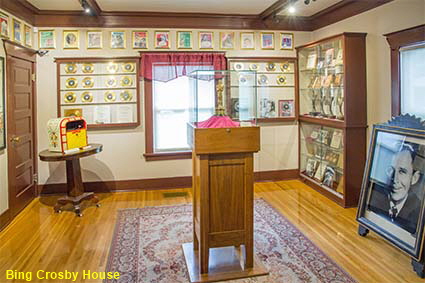
Bing Crosby House
Harry Lillis Crosby was born in 1903 in Tacoma, Washington, then in 1906 his family moved to Spokane where they rented a house. When he was 7 a friend gave Harry the nickname ‘Bingo’ after a comic strip in a local paper. The name stuck and in time it was shortened to ‘Bing’. In 1913 his father built a family house in Sharp Avenue, Spokane. After leaving Gonzaga University without a qualification, Bing joined a local band, but it disbanded after 2 years. In 1925 Bing left for California and by the early 1930s he had become the best known singer in the USA. In the 1940s Bing Crosby developed his film career, appearing in ‘Holiday Inn’ where he sang Irvine Berlin’s ‘White Christmas’ and forging a long term partnership with Bob Hope in the ‘Road to ....’ films. Despite his fame and fortune, Bing Crosby never forgot his old home town of Spokane, returning regularly and becoming a major benefactor to the city including Gonzaga University. Crosby died in 1977 at the end of a round of golf in Spain. The land where his father built a house in 1913 is now part of the Gonzaga University Campus but the house still stands. The Bing Crosby House has a room filled with Crosby memorabilia including (in the centre of the picture) his Oscar for 'Going My Way'. There is no charge for viewing the room. Click Tab 2 for a picture of the exterior of the house.
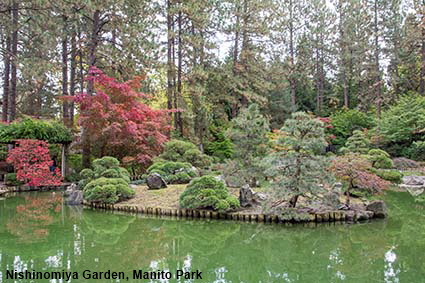
Nishinomiya Garden, Manito Park
Manito Park is a 36 hectare (90 acre) park in the southern suburbs of Spokane. In 1961 the then mayor, Neal Fosseen, established a sister city relationship with Nishinomiya in Japan. As a symbol of this relationship a Japanese garden was built in Manito Park. It was designed by Nagao Sakurai, the former chief landscape architect for the Imperial Palace in Tokyo. Mr Sakurai personally oversaw the implementation of his design until deteriorating health following a stroke forced him to return to Japan.


© Mike Elsden 1981 - 2025
The contents of this page may not be reproduced in full or in part without permission

