Harpers Ferry dates back to about 1750 when English colonist Robert Harper was granted 50 hectares (125 acres) of land. In 1761 he started a ferry across the Potomac River which became popular with settlers heading for the Shenandoah Valley. In 1763 a town known as Shenandoah Falls at Mr. Harper's Ferry was established. In 1799 a US Armoury and Arsenal was built in the town. In 1859 Harpers Ferry became a catalyst for the Civil War when slavery abolitionist John Brown led a band of 21 men to attack the Arsenal. His objective was to seize arms to start a slave uprising in the South. The local militia became alerted to the raid and Brown and his men were forced to take refuge in the Engine House adjacent to the Armoury. Troops arrived two days later and after negotiations failed they stormed the Engine House killing some of the men and capturing the rest. Brown was found guilty of treason and hanged.
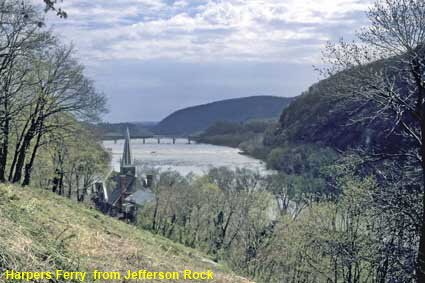
Harpers Ferry from Jefferson Rock
The spire of St Peters Catholic Church stands out in the view from a rock where Thomas Jefferson once looked out over the Potomac River. Harpers Ferry stands in Jefferson County on the confluence of Shenandoah & Potomac Rivers with Maryland on the other side of the Potomac. This was not a good place to be during the Civil War; the Armoury made the town a strategic target and while Maryland took the Union side, Virginia joined to Confederacy. When West Virginia split from Virginia to rejoin the Union, Harpers Ferry remained in Virginia but close to the West Virginia border. The town changed hands eight times between 1861 and 1865. At the end of the Civil War the US Government transferred Berkeley and Jefferson counties to West Virginia making Harpers Ferry the most easterly point in the state.
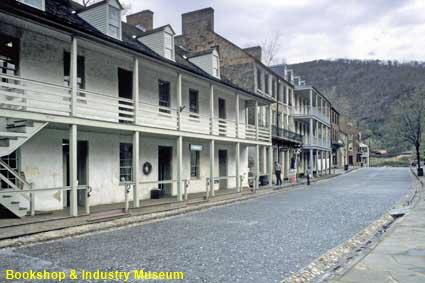
Bookshop & Industry Museum
Since 1944 much of the town and the surrounding area has been preserved as Harpers Ferry National Historical Park. The Appalachian Trail runs through the park. The lower town retains many of its historic buildings and is now a living history museum.
Harpers Ferry
Home > US States > The South > West Virginia >
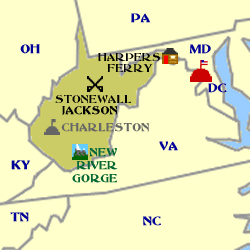
Click on Minimap to navigate
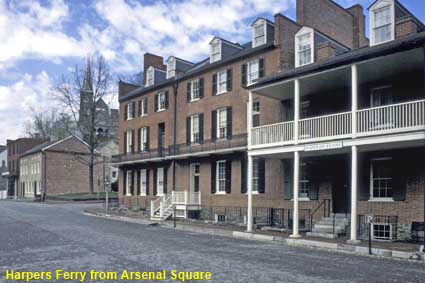
Harpers Ferry from Arsenal Square
Early in the Civil War the Confederates moved the machinery from the arsenal to Richmond where it would be much more secure. The arsenal was never to return to Harpers Ferry and after the war ended the lower town area close to the river was a virtual ghost town. However, the town that saw John Brown take action that helped to push the US into Civil War over slavery became active in supporting the rights of African Americans. In 1865 Storer College opened to provide education for freed slaves, and in 1906 the college hosted the second conference of the Niagara Movement, an early civil rights organisation. In 1888 African American Thomas Lovett built the Hilltop House Hotel which he ran for 34 years, enough time to see the town became a fashionable resort for the residents of Washington DC and Baltimore. Sadly, at the time of writing the hotel was closed.
DLU110719



To move forwards or backwards through the West Virginia trail click the arrows above, or select your next destination on the Minimap.


© Mike Elsden 1981 - 2025
The contents of this page may not be reproduced in full or in part without permission

