Virginia’s first capital was Jamestown, but its island location was prone to malarial mosquitoes and the State House kept burning down. After the 1676 fire the legislative assembly moved temporarily to Middle Plantation, a town founded in 1632 on higher ground with few mosquitoes. When the next State House burned down in 1698, the legislators decided to move the capital to Middle Plantation. It was renamed Williamsburg in honour of King William III and it thrived until the Revolutionary War. The British Navy held control of the coast so in 1780 it was decided to move the capital inland to Richmond. The old colonial capital at Williamsburg declined while a new Williamsburg sprang up around it. Work to preserve and restore the colonial capital began in the 1920s.
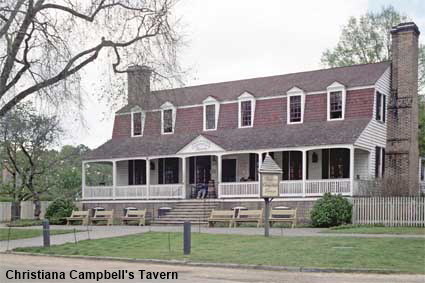
Christiana Campbell's Tavern
As a Living History Museum, Colonial Williamsburg has the historic buildings of an Open Air Museum together with people dressed in period costumes re-enacting the daily lives of the people of the colonial era. While most of the buildings are used to show how people lived in that era, some are used for commercial purposes such as restaurants or shops. Christiana Campbell’s Tavern is an example of the latter. The original tavern was a regular haunt of George Washington and the Williamsburg Masonic Lodge met in the private club room. The tavern in modern Colonial Williamsburg is a working restaurant.
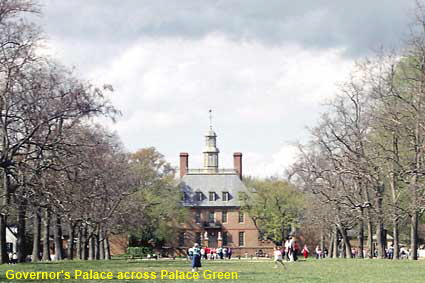
Governor's Palace across Palace Green
Construction of the Governor’s House began in 1706 but it was not finished until 1722. Spiralling costs caused numerous interruptions to the building work and resulted in the perception that it was a palace rather than a mere house. After the capital moved to Richmond in 1780, the palace was used briefly as a Revolutionary War hospital before it burned down in December 1781. The site then passed to the College of William and Mary who constructed two buildings, but fortunately not on the exact site of the palace. Archaeological digs in the 1930s found the footings, the cellars, part of a wall and a great deal of debris from the fire. The Governor’s Palace was reconstructed as part of Colonial Williamsburg and it has been furnished in period style.
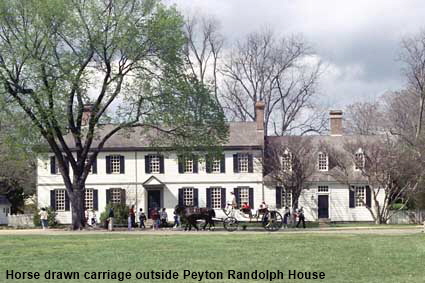
Horse drawn carriage outside Peyton Randolph House
The west wing of the Peyton Randolph House dates back to 1715 when it was built by William Robertson. Sir John Randolph purchased the house in 1721 then in 1724 he purchased the adjoining lot to build a second house. On his death ownership of both houses passed to his son Peyton Randolph, who built a central section to join the two houses together. Peyton Randolph became the first President of the Continental Congress. Restoration of the house began in the late 1930s. Since this picture was taken in 1990 the colour of the house has been changed to deep red and reproductions of the colonial era outbuildings have been added.
Colonial Williamsburg
Click on Minimap to navigate
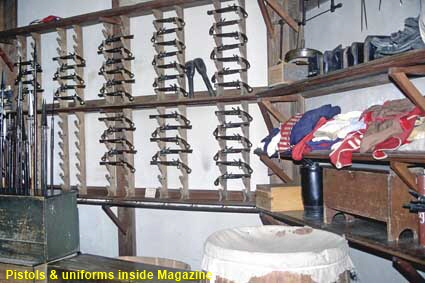
Pistols & uniforms inside Magazine
After becoming capital Williamsburg needed needed to beef up its secure storage for the arms and munitions needed to protect it from Indians, slave revolts, riots, and pirate raids. In 1715 Governor Alexander Spotswood built a tall octagonal tower for this purpose. In the Magazine were kept Brown Bess flintlocks, shot, powder, flints, swords and pikes as well as tents, tools, canteens and cooking utensils. The magazine was used for several different purposes after the capital moved to Richmond, but during the Civil War it was used again as an arsenal. A wall of the Magazine collapsed in 1888 and in 1889 the roof burned. It was restored in the 1930s.
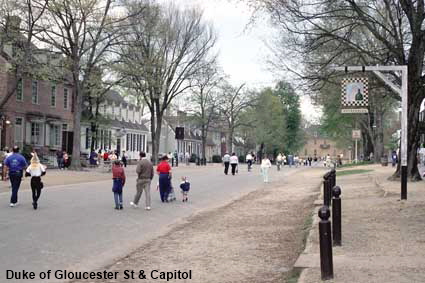
Duke of Gloucester St & Capitol from near Wetterburn Tavern
Colonial Williamsburg was a small city by modern standards, never exceeding 2,000 people. Even so, Williamsburg had some fine buildings by the time the time the capital moved to Richmond. Reverend Dr. W.A.R. Goodwin started a movement to preserve the remaining colonial buildings in 1924 and by 1928 this had resulted in plans for restoration being approved. Over 600 post colonial buildings were demolished. There were 88 original buildings that could be restored and a further were 500 recreated from early plans and archaeological evidence. Colonial Williamsburg is now one of the largest Living History Museums in the world and probably the grandest.
DLU100708



To move forwards or backwards through the Virginia trail click the arrows above, or select your next destination on the Minimap.


© Mike Elsden 1981 - 2025
The contents of this page may not be reproduced in full or in part without permission

