Charles Town was founded in 1670 as the capital city of the new colony of Carolina. Unfortunately it was founded in the wrong place, on the western shore of the Ashley River. In 1690 the town was moved to the more defendable peninsula on the other side of the river, the site of modern day Charleston. The town grew fast and within 80 years it had become the fourth largest port in the colonies. The Civil War brought and end to the boom times. The city was bombarded by Union forces causing major damage and there was further damage in an 1886 earthquake. Charleston went into decline and became a backwater where little development took place. Nowadays the city is an absolute gem with a downtown area that has managed to retain much of its 18th century character. If you go anywhere in South Carolina, make sure that it is Charleston.
Charleston
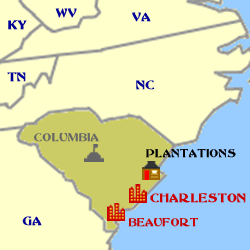
Click on Minimap to navigate
Home > US States > The South > South Carolina >
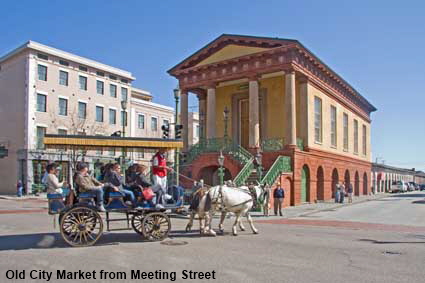
Old City Market from Meeting Street
It may look a bit like an Open Air Museum, but this is a real, living city. The Old City Market is a typical example of an historic building still in use for its original purpose. Charles Cotesworth Pinckney ceded this land to the City of Charleston in 1788 with a stipulation that a public market should be built on the site and that it should continue in use as a public market in perpetuity. The market was built between 1804 and the 1830s and it stretches from Meeting Street to the waterfront. The Market Hall, shown in this picture, was added in 1841. In accordance with Charles Pinckney’s wishes, the long market arcade thet stretches behind the Market Hall is still filled with shops and market stalls.
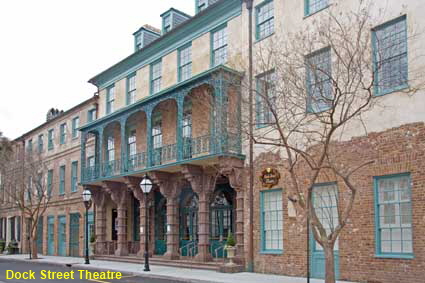
Dock Street Theatre, Church Street
Its wrought iron balcony ensures that the Dock Street Theatre stands out among the buildings in Church Street. The original Dock Street Theatre built in 1736 was the first purpose-built theatre in North America, but it is believed to have burned down during a major fire in 1740. The current theatre, built on the same site, was originally the Planters Hotel but during the depression work was funded to convert it in to a theatre modelled on 18th century London playhouses. When this photograph was taken in March 2010 the theatre was about to reopen after major refurbishment.
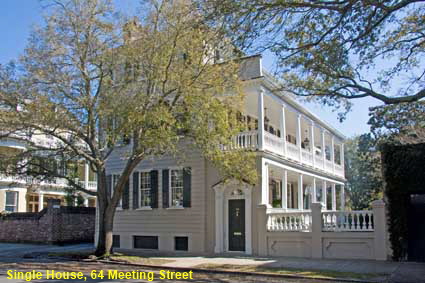
Single House, 64 Meeting Street
The best way to appreciate the historic architecture of Charleston is on foot. Meeting Street between Battery Street and Market Street is full of fine examples of Charleston architecture. The ‘single house’ is a Charleston speciality, just one room wide so that in summer the cooling sea breezes can flow through it. In most cities, the walkways along the outside of a building would be called porches, balconies, verandas or galleries but in Charleston they are called piazzas. The piazza of a single house is on the south side so that it provides shade for the rooms. The front door does not take you into a room, but to the open piazza.
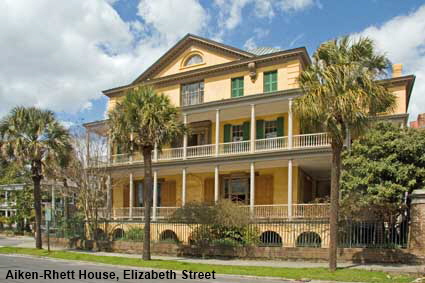
Aiken-Rhett House, Elizabeth Street
There are several historic houses in Charleston that are open to the public, and we have chosen as an example one that is a little north of the main tourist area. It was built for Charleston merchant John Robinson in 1817 but after losing several ships at sea he was forced to sell the house to William Aiken Senior in 1827. Aiken died in a carriage accident in 1831 and the house passed his son William Aiken Junior, who later became Governor of South Carolina. The current look of the house is the result of major extensions by William Aiken Junior in the 1830s and 1850s. Descendants of Aiken lived in the house until the 1970s, but few changes were made to it. The Aiken-Rhett house is now owned by the Historic Charleston Foundation which has preserved it and opened it to the public.
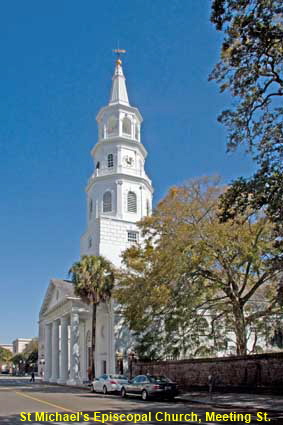
St Michael's Episcopal Church, Meeting Street
In most American cities the church spires have long been dwarfed by huge skyscrapers. Charleston remains a low rise city where the spires of the churches are still prominent in the skyline and as a result it is sometimes called the Holy City. On the corner of Meeting Street and Broad Street stands a fine example of a Charleston Church. St Michael's Episcopal Church is the oldest church in Charleston and it stands on the site of the first Anglican Church built south of Virginia. Although the architect is unknown, the church was designed in the style of Sir Christopher Wren. It opened for services in 1761 and apart from the addition of the sacristy in 1883, the building has changed little since then. The 56.7 metre (186 foot) high tower sank 20 centimetres (8 inches) in the 1886 earthquake measuring 7.5 on the Richter scale, but it survived intact. Click Tab 2 to see the interior of the church complete with the original pulpit.


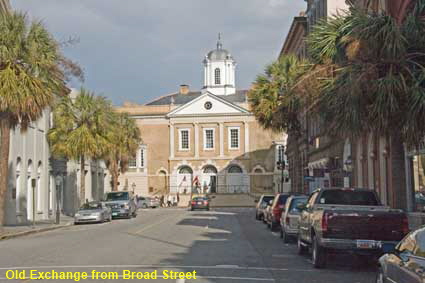
Old Exchange from Broad Street
In the mid 18th century the city was still called Charles Town and trade was booming. Wealthy merchants and investors put pressure on the city authorities to build an Exchange to support growing trade. An act was passed in 1767 for the building of an ‘Exchange or Custom House’ and it was completed in 1772. Over the years that followed, the building was used as a customs house, mercantile exchange, post office, military prison, barracks and brothel. The restored Old Exchange is a museum with the basement restored as ‘The Provost Dungeon’ where some (but not all) of the former uses of the building are recreated. Click Tab 2 to see the 'Customs Officer' in the Provost Dungeon.


DLU101105



To move forwards or backwards through the South Carolina trail click the arrows above, or select your next destination on the Minimap.


© Mike Elsden 1981 - 2025
The contents of this page may not be reproduced in full or in part without permission

