Just like Guthrie, its predecessor as state capital, Oklahoma City sprang up during the 1889 Land Run with around 10,000 people claiming land in the area now occupied by the city. In 1890 the city was incorporated and its connections to multiple railroads fuelled rapid growth as it became a major centre for trade, milling, and meat packing. By 1910 Oklahoma City had a population in excess of 60,000 and the people of Oklahoma voted to move the state capital from Guthrie to Oklahoma City. The government moved immediately to the new capital using the Lee-Huckins Hotel as a temporary capitol building until the permanent capitol was built in 1917. In 1928 an oil field was discovered beneath the city which was at the time the largest oil strike ever made. Oil wealth allowed Oklahoma City to boom through the great depression and right through to the 1960s by which time oil production was decreasing and the city went into decline. In the 1970s and into the 1980s city leaders attempted to revitalise Oklahoma City by implementing a programme of urban renewal that saw many of the city’s historic buildings demolished and replaced by modern ones. The sacrifice of historic buildings did little to turn round the fortunes of the city. In the 1990s the Metropolitan Area Projects (MAPS) scheme used a sales tax to pay for renovations, a scheme that proved much more successful. Sadly the success of MAPS was overshadowed in 1995 when a terrorist bomb planted in the downtown area killed 168 people in a federal building.
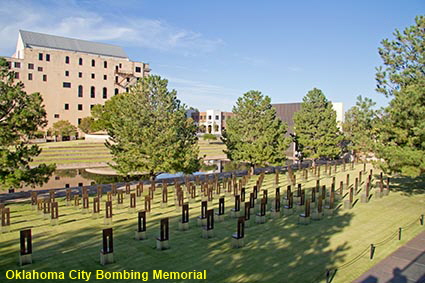
Oklahoma City Bombing Memorial
At 09:02 on April 19, 1995 a huge fertiliser bomb planted in a rented Ryder truck exploded in front of the Murrah Federal Building in Oklahoma City. The entire north face of the 9 storey building was destroyed and 168 people killed including 19 children in the daycare centre. The blast also caused major damage to a further 324 buildings. 90 minutes later a police officer pulled over a car because it had no license plate. The officer found an unlicensed firearm in the car so the driver Timothy McVeigh was arrested. While he was under arrest, police discovered documents that linked him to the terrorist attack, and forensic evidence soon confirmed this. Two days later police identified Terry Nicholls as a suspect who may have helped to build of the bomb and he turned himself in. McVeigh was tried for the bombing in 1997, he was found guilty and sentence to death. Nicholls was also tried for conspiracy to build a weapon of mass destruction, he was found guilty an sentenced to life imprisonment without parole. The State of Oklahoma tried Nicholls again in 2000 in attempt to impose the death penalty, but the jury was deadlocked on the death penalty. A third accomplice, Michael Fortier, testified against McVeigh and Nicholls so his sentence was just 12 years and a fine. Why did McVeigh perform such a terrible terrorist attack? He was angered by the FBI standoff at the Branch Davidian Cult in Waco in Texas which resulted in the deaths of 75 members of the cult so he decided to take revenge. McVeigh was executed on June 11, 2001. The remains of the Murrah Federal Building were demolished on May 23, 1995 and in 2000 this memorial was built on the location to remember victims of the Oklahoma City Bombing.
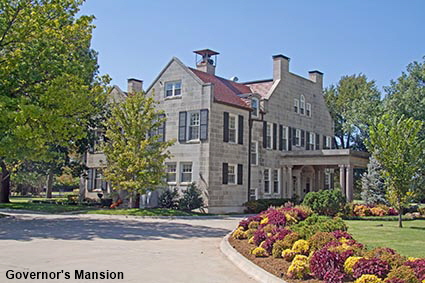
Governor's Mansion
When Oklahoma became a state, the governor had to live in a private residence or hotel. When plans for the state capitol were approved in 1914 a plot of land was set aside to the east of the capitol for a governor’s mansion, but because of budget constraints nothing was built on the plot. All of this changed in the 1920s when the discovery of oil removed all of the questions about the affordability of a mansion. Oklahoma City architectural firm Layton, Hicks and Forsyth was contracted to design and build a mansion. The 19 room Dutch-Colonial style mansion was faced with carthage limestone so that it matched the adjacent capitol. The mansion was restored in the 1990s with the number of rooms reduced to 12 in order to increase the private living space for the governor and his family. The Governor’s Mansion is open for guided tours certain days of the year
Oklahoma City
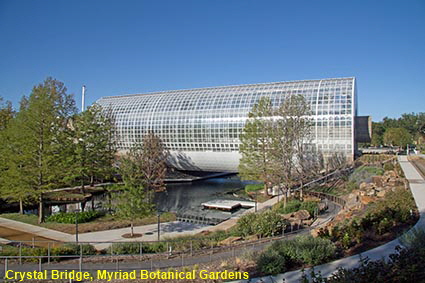
Crystal Bridge, Myriad Botanical Gardens
The idea of building a Botanical garden in downtown Oklahoma City dates back to 1964 when the city leaders commissioned I M Pei to create a revitalization plan for downtown Oklahoma City. Work on the 7 hectare (17 acre) Myriad Botanical Gardens began in 1977 and they opened to the public in 1988. The gardens surround a sunken lake and crossing the lake is a 68 metre (224 foot) long cylindrical conservatory called the Crystal Bridge Tropical Conservatory. Inside there is a 10 metre (35 foot) waterfall and over 2,000 varieties of tropical plants broken up into two distinct zones, a Wet Tropical Zone and a Dry Tropical Zone. Click Tab 2 to see the interior of the Crystal Bridge from the upper walkway.
DLU170307
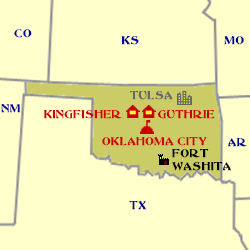
Click on Minimap to navigate
Home > US States > The Southwest > Oklahoma >



To move forwards or backwards through the Oklahoma trail click the arrows above, or select your next destination on the Minimap.




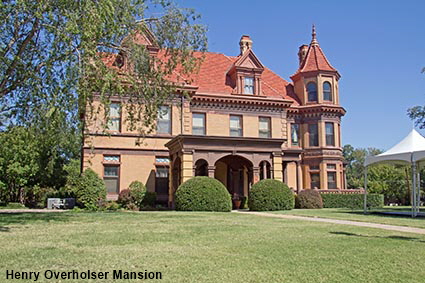
Henry Overholser Mansion
Henry Overholser was born and brought up in Ohio then he moved to Indiana where he worked in a mercantile business. Later he started his own real estate and building businesses in Colorado and Wisconsin which made him a fortune. He arrived in the Oklahoma Territory in 1899 and started buying lots and developing commercial buildings in the area where Oklahoma City now stands. In 1902 he purchased three lots in the newly developed Classen’s Highland Park Addition more than a mile north of the centre of the city. In 1903 he built a mansion on the land in the Queen Anne and Chateauesque architectural styles which by then were regarded as rather old fashioned. Henry died in 1915 and his wife Anna in 1940. The house was then passed to their daughter who lived in the house with her husband David Jay Perry until her death in 1959. The Perrys had no children and in 1972 David Jay Perry sold the house to the Oklahoma Historical Society. The Henry Overholser Mansion is now a house museum open to the public. Click Tab 2 to see the interior of the Dining Room
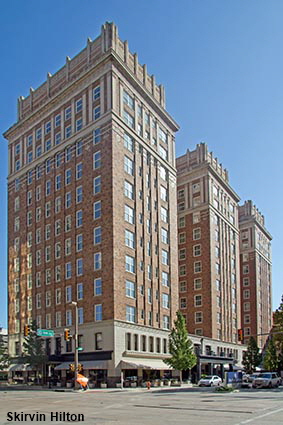
Skirvin Hilton
The Skirvin Hotel opened in 1911. It was built by William Balser Skirvin from Michigan who moved Guthrie in the Oklahoma Territory in the 1889 Land Rush where he established a real estate business. He then moved to Galveston in Texas where he was involved in both the real estate and oil businesses. In 1906 he he returned to Oklahoma, attracted by both real estate and oil opportunities. Between 1910 and 1911 he built the Skirvin Hotel, initially two 10 storey towers and 224 rooms. A third tower tower was added in 1925 and in 1930 all three towers were raised to 14 storeys. Skirvin died in 1945 and his family sold the 500 room hotel to hotelier Dan James for $3 million. Over the next 43 years it passed through several hands. It was the best hotel in town with guests that included Harry Truman, Dwight D. Eisenhower, Elvis Presley, Frank Sinatra, Jimmy Hoffa and Bob Hope. When the boom years came to an end the hotel suffered but it managed to stagger on until 1988 and hence avoided demolition under the urban renewal programme. After the hotel closed the building was left abandoned. In 1999 under the Metropolitan Area Projects scheme the City Mayor set up a committee to evaluate whether the historic building could be saved. After reviewing other historic hotels that had been brought back from the dead the committee recommended that the City authorities should explore creating a public-private partnership to get the Skirvin re-opened. The City acquired the former hotel in May 2002 and invited proposals from private developers to renovate and reopen it. The resultant partnership was successful and after a $50 million renovation the hotel reopened in 2007 as the Skirvin Hilton Hotel.
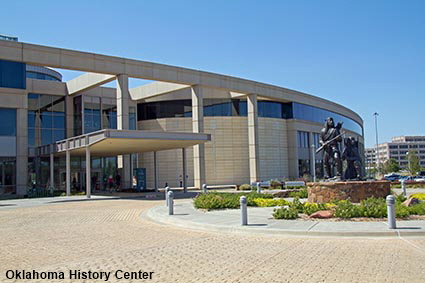
Oklahoma History Center
A lot of the history of Oklahoma City was destroyed in the 1970s and 1980s under the urban renewal programme. Perhaps it was to make amends for this that in 2005 the City opened the Oklahoma History Center on a 7.3 hectare (18 acre) site adjacent to both the Capitol and the Governor's Mansion. This large, modern museum preserves the history of Oklahoma from the days of the Plains Indians, through the resettlement of Indians from the south, the Land Runs, the oil boom and up to the modern day. The museum is operated by the Oklahoma Historical Society. Click Tab 2 to see a Stagecoach exhibited in the History Center.
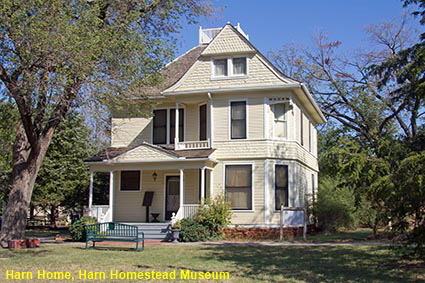
Harn Home, Harn Homestead Museum
An unfortunate but inevitable consequence of the 1889 Land Run was an explosion in the number of land disputes. Secretary of the Interior John W Noble concluded that many of these disputes were due to ‘Sooners’ (as the 1889 Land Run claimants were known) committing perjury on their claim forms. In 1891 he appointed Ohio Lawyer and Newspaper Publisher William Fremont Harn a special land commissioner in Oklahoma Territory to investigate suspect claims. Together with his wife Alice, Harn moved to the Oklahoma Territory and bought 64 hectares(160 acres) of land in what is now Oklahoma City. The land became known as the Harn Homestead. Harn’s investigations resulted in several ‘Sooners’ being sent to prison, but in 1893 the new Democrat administration fired him. Alice Harn was keen to return to Ohio, but William wanted to stay so he promised her a house of her choice if they stayed. She chose a Queen Anne style house which was made in Chicago, shipped by train and assembled at the Harn Homestead. The Harn’s did not have children but their niece lived with them and she inherited the Homestead in 1944 when William Harn died. She lived in the house until 1967 when she deeded the property to the City as a museum. The Harn Homestead Museum comprises the original house and outbuildings, some cabins and a one room schoolhouse. Click Tab 2 to see the Parlor.
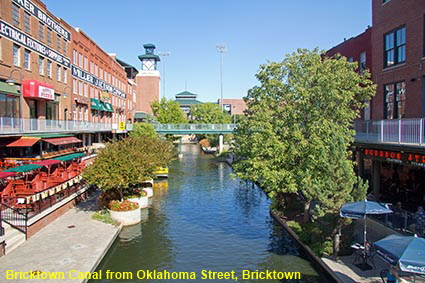
Bricktown Canal from Oklahoma Street, Bricktown
Bricktown is an area east of downtown Oklahoma City where four railroad companies had their freight yards. It gained its name from the large brick buildings built there between 1898 and 1930. The decline of the area began in the Great Depression and accelerated after World War II as traffic moved from rail to road. The area became run down and residents moved out to better accommodation elsewhere. By 1980 most buildings in Bricktown were derelict. In the 1990s the Metropolitan Area Projects (MAPS) scheme came up with proposals to revitalise the area. The main elements of the plan a were ballpark and also a canal linking downtown to Bricktown and the Oklahoma River which would carry visitors to the ballpark plus new shops, restaurants and nightclubs. The ballpark opened in 1998 and the canal in 1999. As can be seen in this picture, the area is now far from derelict.


© Mike Elsden 1981 - 2025
The contents of this page may not be reproduced in full or in part without permission

