New Castle
New Castle is a place that has had many names. It was known as Tomakonck (Place of the Beaver) to the local Indians until the Dutch West India Company arrived in 1651. Led by Peter Stuyvesant they established a settlement that they called Fort Casimir. In 1654 Sweden seized to colony and changed the name of the settlement to Fort Trinity. When th Dutch reasserted control the following year they abandoned the Fort Casimir name and instead called it Nieuw-Amstel. When the British took over in 1664 they gave the settlement the name New Castle and apart from a brief spell of Dutch control in 1673, the name has stayed the same ever since. In 1681 King Charles II gave William Penn land in North America to repay debts he owed to Penn’s father. Penn established the Province of Pennsylvania on the land and it was at New Castle in 1682 that William Penn first set foot in North America and he used it as his centre of government until Philadelphia was founded. In 1776 New Castle was made the capital of the newly declared state of Delaware, but vulnerability to British raids forced the capital to be moved to Dover the following year. Nearby Wilmington boomed during the Civil War and New Castle became a bit of a backwater, leaving it with a wealth of historic buildings that might otherwise have been torn down.
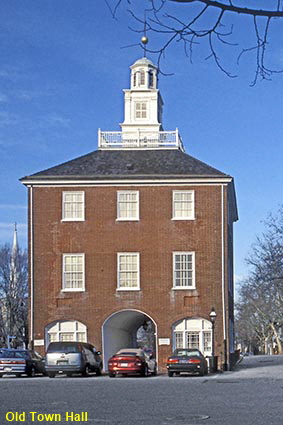
Old Town Hall
Compared to some of the other buildings in New Castle, the Old Town Hall is a youngster. This brick three storey, three bay building was built between 1823 and 1826. The octagonal cupola on top makes it very recognisable; you will no doubt spot it in the Courthouse picture above. The arch through the centre of the building was designed to allow farm wagons access to the market on market days. Some city offices are still based here as well as the offices of a local newspaper and the trustees of New Castle Green.
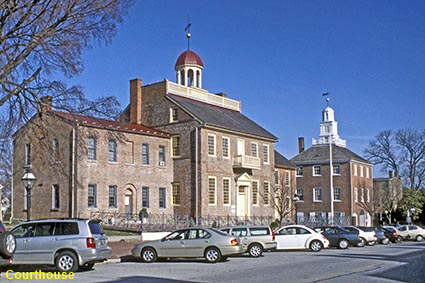
Courthouse
The New Castle Courthouse was built in 1732 over the remains of a courthouse dating from the 1680s. The courthouse cupola marks the centre of the 19 kilometre (12 mile) radius arc of a circle that forms the border between Delaware and Pennsylvania. In addition to being a courthouse, the building was also the meeting place for the colonial government. On June 15, 1776, the legislature met in the courthouse and passed a Separation Resolution severing links with Britain and creating the state of Delaware. The courthouse was used as the capitol for the new state until the seat of government moved to Dover. The building is now open to the public as New Castle Court House Museum.
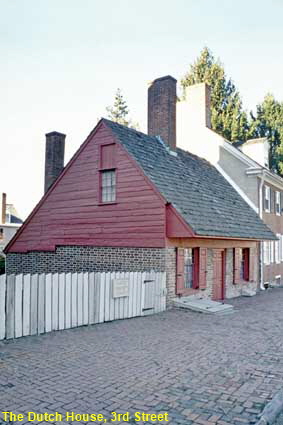
The Dutch House, 3rd Street
Of the many well preserved old houses in New castle, the Dutch House is one of the earliest, dating from the late 17th century. It was modified in the 18th and 19th centuries but the original interior framing system is still there. The reason why it is called the Dutch House has been long forgotten, it was built after the British took control of the area but maybe the original owner was of Dutch descent. The Dutch House was purchased in 1937 by the Delaware Society for the Preservation of Antiquities who restored it and opened it as an historic house museum.
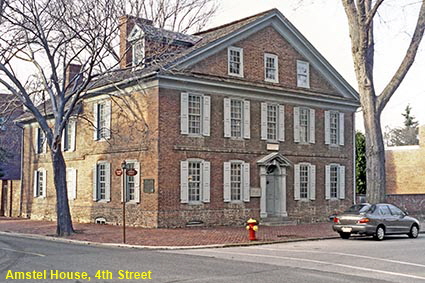
Amstel House, 4th Street
Amstel House was built in the 1730s by by wealthy landowner Dr. John Finney. Later in the 18th century it was for a time the home of the 7th Governor of Delaware, Nicholas Van Dyke. George Washington visited the house to attend a wedding in 1784. The house had several other wealthy owners until in the 20th century it was renovation by noted Delaware architect and preservationist Laussat Rogers. Amstel House opened in 1929 as an historic house museum and continues as such today.
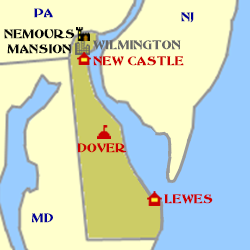
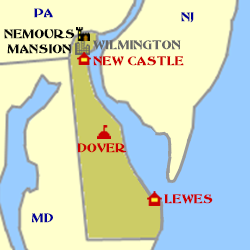
Click on Minimap to navigate
DLU170331



Home > US States > Midatlantic USA > Delaware >
To move forwards or backwards through the Delaware trail click the arrows above, or select your next destination on the Minimap.
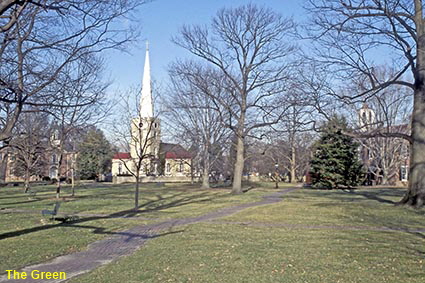
The Green
The Green is a common in the middle of New Castle which dates right back to the days when the Dutch laid out Nieuw-Amstel. In the middle of the picture is Immanuel Church on the Green, an Episcopal church founded in 1689. Construction of the church building began in 1703 and it was largely complete by 1708.


© Mike Elsden 1981 - 2025
The contents of this page may not be reproduced in full or in part without permission

