Historic St. Mary’s City
The first 300 settlers arrived aboard the ships ‘The Ark’ and ‘The Dove’ in March 1634, led by Leonard Calvert, the younger brother of Baron Baltimore. They bought 12 hectares (30 acres) of land from the chief of the Piscataway Indians and established their first settlement on the land overlooking the estuary of St. Mary's river close to where it joins the Potomac. Many of the settlers were Catholic so the name given to the settlement of St Mary’s City is thought to have been in honour of the Virgin Mary. The town was laid out and became the meeting place of the Maryland Assembly. In 1644 the religious intolerance inspired by the English Civil War arrived in the colonies and Protestant raiders took control of the city. In 1647 a militia led by Leonard Calvert retook the city and St Mary’s City resumed its role as capital until 1689 when Protestants revolted against the rule of the Calverts. The British Crown replaced the Calverts with governors who passed laws restricting the rights of Catholics. In 1695 they moved the capital of Maryland to Anne Arundel Town which they renamed Annapolis. St Mary’s City was abandoned the buildings disappeared and the land was used for agriculture. Archaeological digs in the 1980s identified the location and layout of the city. Having identified the layout of the city, it was decided to recreate some of the buildings, a few on their original sites but most of them on different sites. The recreation was named Historic St.Mary’s City and it is open to the public from March through to November.
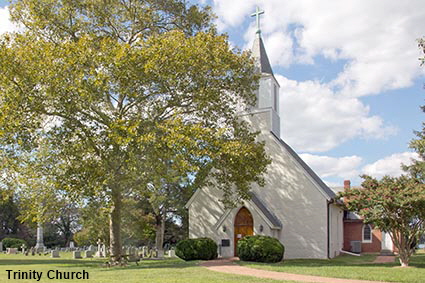
Trinity Church
This Episcopal church was not present when St. Mary’s City stood here, it was built in the early 1830s using bricks from the original State House.
Home > US States > Midatlantic USA > Maryland >
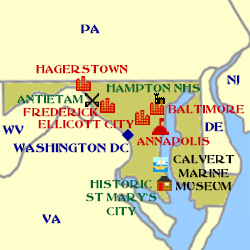
Click on Minimap to navigate
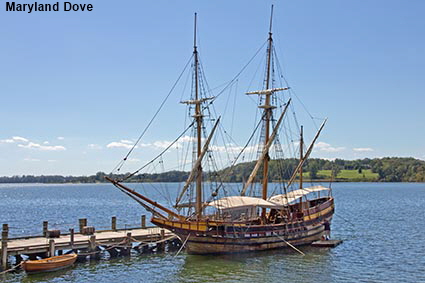
Maryland Dove
‘The Dove’ was the smaller of the two ships that brought the firt settlers to Maryland. In 1978 a recreation called the ‘Maryland Dove’ was launched and she now forms part Historic St. Mary’s City.
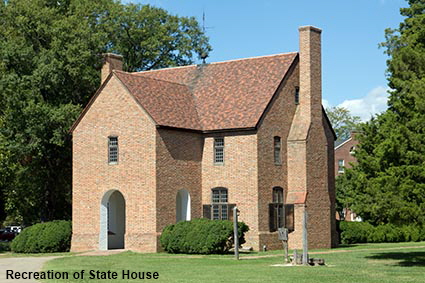
Recreated State House
The most important building in St. Mary’s City was the State House where the Colonial Assembly met. A brick State House was constructed in 1676. Evidence from archaeological digs has provided evidence to enable it to be recreated on a separate site in Historic St. Mary’s City. Click Tab 2 to see the Council Chamber on the upper floor.
DLU170528


To move forwards or backwards through the Maryland trail click the arrows above, or select your next destination on the Minimap.

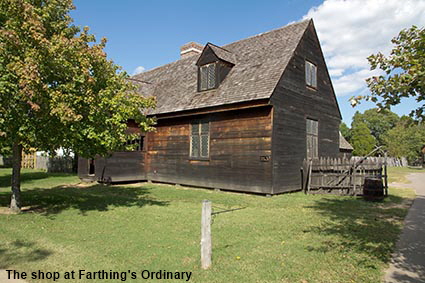
The shop at Farthing's Ordinary
This is a recreation of a late 1600s public inn. It serves as the museum shop and also has restrooms.
Chapel & MacKall Barn
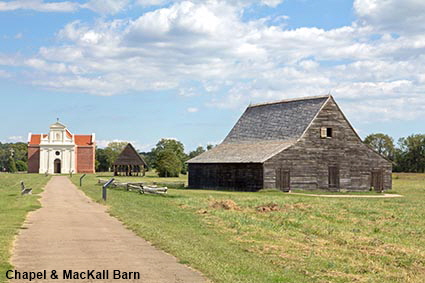
On the left is a recreation of the Brick Chapel built in 1667, while the structure on the right is an original building, albeit one that post dates St.Mary’s City. Tree ring dating indicates that the MacKall Barn dates back to 1785, 90 years after the city was abandoned. The barn now houses an exhibition of the architecture of the city and the story of its abandonment.
Print House
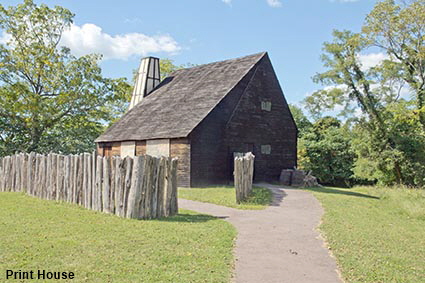
One of the few buildings recreated on its original site is the Print House. It is thought that the original building was constructed by Garrett Van Sweringen for use as a public inn. Excavations revealed many pieces of printing type on the site indicating that Maryland’s first printer, William Nuthead, must have operated his press here.
Van Sweringen's Inn
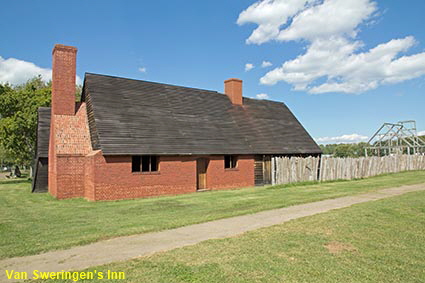
A brick hotel was built in St. Mary’s City by Dutch immigrant Garrett Van Sweringen. The kitchen and cellar have been recreated.




© Mike Elsden 1981 - 2025
The contents of this page may not be reproduced in full or in part without permission

