Calvert Marine Museum
Solomons sits at the end of a peninsula separating the Patuxent River from Chesapeake Bay. With water on three sides of the peninsula, it is an area with a lot of maritime history and hence an ideal location to open a marine museum. The original Calvert Marine Museum opened on Solomon's Island on October 18, 1970. Space on Solomon’s Island (which is actually a peninsula) was limited and within 5 years the museum had outgrown the space available. In 1975 it moved just north of Solomon’s Island to its current 3.6 hectare (9 acre) site. The new site provided enough space to move the abandoned Drum Point Lighthouse to the museum.
North American River Otter
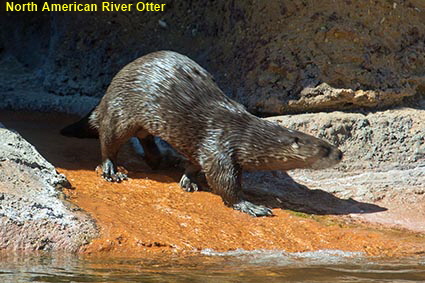
The museum is not just about the boats and lighthouse, it also has an Estuarine Biology Gallery that tells the story of the diverse marine life found in Chesapeake Bay and its tributaries. The display of North American River Otters is fascinating if you are as lucky as we were and get a close up view of them.
Home > US States > Midatlantic USA > Maryland >
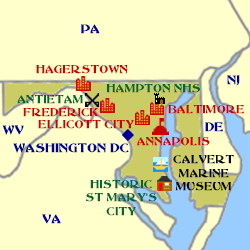
Click on Minimap to navigate
Reconstruction of Megatooth Shark
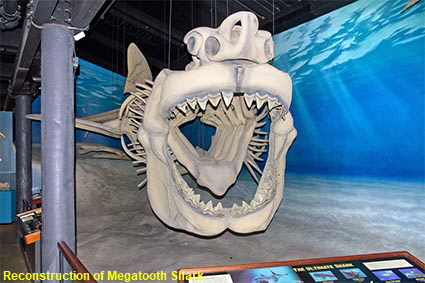
The Calvert Cliffs on the shore of Chesapeake Bay not far from the museum have proved a rich source of fossils. The fossils are mainly of marine animals from the Miocene era, about 23 to 5.3 million years ago. The museum displays a range of fossils including shells, sharks’ teeth, and bones. One of the most striking exhibits is this reconstruction of a long extinct Megatooth Shark.
Drum Point Lighthouse
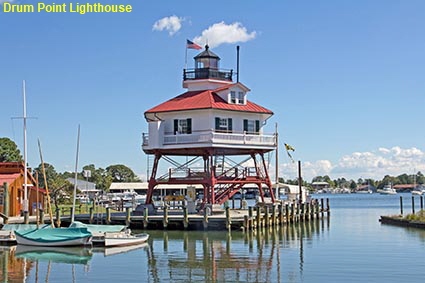
At the end of the peninsula separating the Patuxent River from Chesapeake Bay is Drum Point. In 1838 Lt. William D. Porter recommended that a light be built at Drum Point to mark the entrance to the Patuxent River, but it was not until 1853 that money was allocated to build a lighthouse on land near the point. It was never built, probably because the landowner was not prepared to sell. In 1874 steamboat captains petitioned Congress for a lighthouse at Drum Point. Since a site on land had proved difficult to secure, attention turned to a submarine site as this required only State approval. A plot of submerged land south of Drum Point was transferred to Federal ownership and in 1883 a lighthouse was built on the site. It was a screwpile lighthouse; a wooden superstructure combining the light and keepers cottage mounted on top of wrought iron legs. Drum Point Lighthouse was decommissioned in 1962, after which it was vandalised. In 1975 it was moved to Calvert Marine Museum and restored to how it would have looked in the early 20th century. Click Tab 2 to see the kitchen and Tab 3 for a bedroom inside Drum Point Lighthouse


Log Canoe
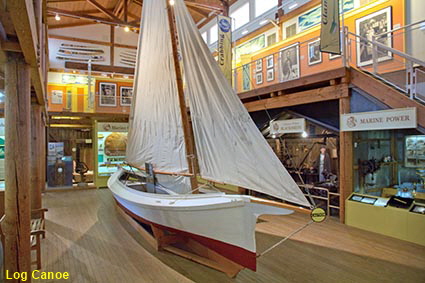
The museum has many examples of historic small craft of Chesapeake Bay and the Patuxent River, including this log canoe. It may not look like a canoe because it has sails, but the origin of this small craft lies in the canoes built by the native Powhatan tribes along the shore of Chesapeake Bay. They made their canoes using logs from loblolly pine or tulip poplar trees. The inside of the log was slowly burned, then the ashes were scraped away to create a canoe. The early settlers discovered that these craft could handle the rough waters of Chesapeake Bay while carrying a heavy load, so they adopted the same design adding a sail to make it go faster. As the supply of large trees dwindled, canoe builders had to use several logs to make a canoe. Poquoson in Virginia became known for its log canoes built using three logs with added sails, a centreboard, and washboards.
DLU170512


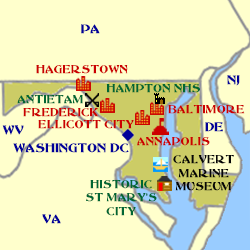
To move forwards or backwards through the Maryland trail click the arrows above, or select your next destination on the Minimap.




© Mike Elsden 1981 - 2025
The contents of this page may not be reproduced in full or in part without permission

