The first building here was a warehouse on the bank on the Potomac River where tobacco was inspected prior to sale under a 1730 Virginia Law. The cultivation of grain in upland areas led to the founding of Alexandria in 1749 as a port for export of grain and import of supplies. Alexandria is the town that moved twice. In 1791 it became part of Washington DC, but later residents voted to return to Virginia. Was this because of the lack of a station on the Washington Metro? No, it happened way back in 1847, and the issue then was slavery. Alexandria had lost business to Baltimore but it remained major port for the import of slaves, and residents feared a ban in DC. The Civil War ended the slave trade and Alexandria became a quiet backwater. This helped to preserved the town’s considerable heritage.
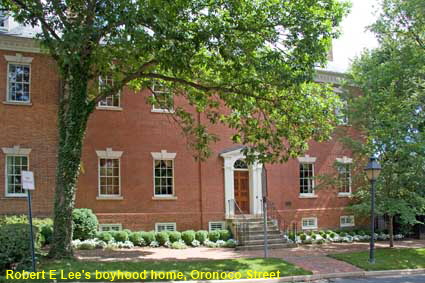
Robert E Lee's boyhood home, Oronoco Street.
This mansion was built around 1795 for John Potts Jr. the first secretary of the Potomac Navigation Company, but Potts was not its most famous resident. Civil War General Robert E Lee was born in 1807 at Stratford Hall Plantation in Virginia. He was the eighth child of Major General Henry Lee and the fifth born to his second wife, Ann Hill Lee. In 1810 mounting debts forced Henry Lee to hand over the plantation to his eldest son, Robert’s half brother Major Henry Lee IV. The family moved to Alexandria to live with relatives. This elegant mansion at 607 Oronoco Street in Alexandria's historic Old Town became the home of Robert E Lee for most of his boyhood years. It is now a private residence and not normally open to the public.
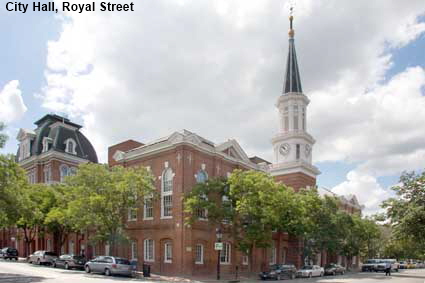
City Hall, Royal Street
When Alexandria was founded way back in 1749 a plot of land was set aside for a Market and Town Hall. The first Town Hall was built in 1752 and was replaced by a new one in 1817. The market on the site included the second-largest slave market in the USA. The current building dates from 1871 when the previous City Hall was destroyed by fire. It is largely a replica of the 1817 building. It is now used solely as a City Hall, but in the past it also served as the court house, firehouse, police headquarters, Masonic headquarters and part of the first floor was used for market stalls.
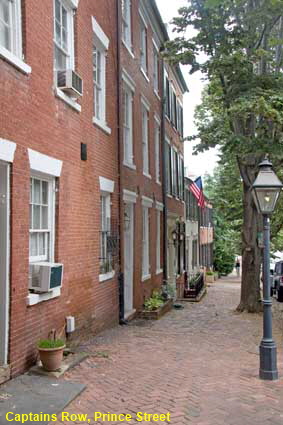
Captains Row, Prince Street
Prince Street, between Lee and Union Streets, has a block of houses known as Captain's Row. This is where in the early days of Alexandria several sea captains and wealthy merchants built Federal style houses. Those houses are now amongst the oldest in the city and they have been very well preserved. With Captain’s Row set against the cobblestone street you could almost imagine that you are back in Colonial times. What shatters the illusion is the cars parked all along the street. Click Tab 2 to see some more old houses, this time in St Asaph Street.
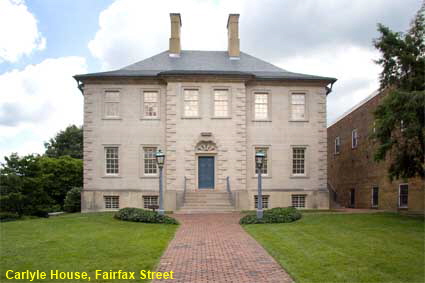
Carlyle House, Fairfax Street
John Carlyle was a Scottish merchant and one of the founders of Alexandria. He married Sarah Fairfax, who came from one of the most influential families in Virginia. Their home in Alexandria was completed in 1753 and on the night that they moved in Sarah gave birth to their first child. Carlyle House is only surviving stone Georgian townhouse in Alexandria. The house has been restored, complete with period furnishings, to provide an insight into the life and times of one of Alexandria's founders and first landowners. Carlyle House is owned by the Northern Virginia Regional Park Authority and it is open to the public for guided tours.
Alexandria
Click on Minimap to navigate
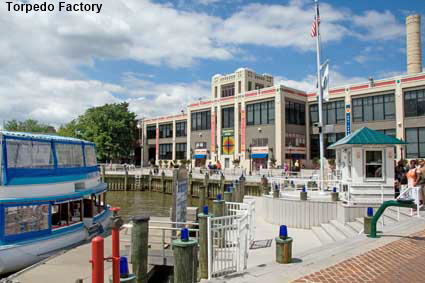
Torpedo Factory
The U.S. Naval Torpedo Station was built in Alexandria at the end of World War I. It was established to meet rising demand for the manufacture and maintenance of torpedoes. Production ceased after five years and the site was used for storing munitions. World War II saw the resumption of torpedo manufacture, but the site closed at the end of the war. For a time the buildings were used for storage, until in 1974 the Torpedo Factory Art Center opened, a place where professional artists could work, exhibit, and sell their art to the public. Today, it is centrepiece of the lively Alexandria waterfront.
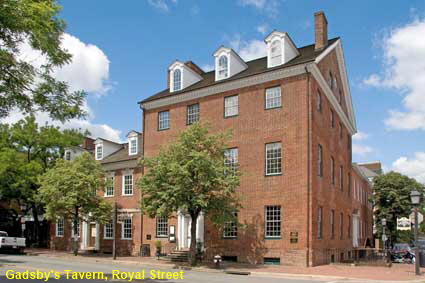
Gadsby's Tavern, Royal Street
Gadsby's Tavern is actually two buildings, a tavern built around 1785 and the 1792 City Hotel. The name comes from Englishman John Gadsby, who leased the buildings and operated them as tavern keeper from 1796 until 1808. The tavern & hotel quickly became the centre of Alexandria's economic, political and social life and remained so in to the 19th century. Nearly all of the founding fathers of the USA enjoyed the hospitality of Gadsby's Tavern. In the early 20th century the buildings were threatened with demolition but they were saved and preserved by the American Legion, Post Twenty-four. The former tavern is now a museum while the former City hotel now houses a restaurant and ballroom.


DLU1000707



To move forwards or backwards through the Virginia trail click the arrows above, or select your next destination on the Minimap.


© Mike Elsden 1981 - 2025
The contents of this page may not be reproduced in full or in part without permission

